
Seu Pedro went to the bank to withdraw money to do his monthly shopping and discovered, in the worst way, that his CPF (Brazilian taxpayer ID) was blocked.
With no food at home and unable to miss work, he sent his wife to look for me because of the "tax sin" he unknowingly committed, but his redemption was impossible because along the way they demanded the receipt numbers for the last two tax returns, which, because they hadn't been submitted, could be the very reason for the blockage!
The Case of Seu Pedro: Chained for R$ 228.00
In truth, he didn't deliver because he didn't really need to: his meager driver's salary has kept him chained to the exempt category for years and, finally, given the urgency of the situation, he was forced to displease his bosses and spend an entire morning visiting the facilities of... Federal Revenue Service only to discover that his entire family was being penalized for not filing their 2020 taxes.
After I instructed him to request all income statements from the garage since 2019, his wife returned a couple of days later so that I could finally free them from the shame of having to ask family and neighbors for money to eat, and the following image reveals the absurdity of the situation:

Knowing that the exemption limit is equivalent to R$ 28,559.70, I was able to verify that in that year Pedro was forced to work some arduous extra shifts and ended up receiving a ridiculous R$ 228.13 in addition to the exempt amount: it was enough to transcribe the data for the partial refund to be immediately offered through the simplified model.
By including information about his wife and child, the entire "substantial" amount withheld at source became available, but by then it was too late: the simple bus driver was subjected to an irrevocable and hefty fine of R$ 165.74.
Specifically, it wasn't necessary to declare the subsequent years because Mr. Pedro's income returned to the meager normality of the exemption limits…
I've heard of hackers hijacking computers and only unlocking them after receiving some kind of ransom, usually an exorbitant amount, but seeing a government freeze a family's meager income to extort a "fine"—which, by the way, is completely disproportionate to the amounts that were never owed—only proves that the control enabled by technology is already an impersonal and terribly malevolent tormentor.
And it's only going to get worse…
Of the many unnecessarily painful episodes I've witnessed and helped resolve, this was undoubtedly one of the most outrageous... so much so that afterwards I even decided to make a somewhat didactic announcement:

I'm sometimes asked if I'm an accountant, but I'm not ashamed to say that I only know how to deal with individuals, that is, so-called "natural persons," and this is a hobby that interests me so much that, while working as a receptionist at an accounting event, I once found myself giving instructions to a professional accountant who simply ignored some of the tricky details of the tax returns!
Pride aside, I simply don't make the slightest effort to delve into corporate tax regulations, and I shudder at the mere thought of the risk of dealing with potential omissions among the tons of data coming from a legal entity.
I feel it's important to clarify to people that the tax has already been deducted from their salaries without their authorization or knowledge, as well as to disillusion those who arrive saying that "the SUS [Brazilian public healthcare system] is free"... From the experiences I had in 2022 (and always absolutely preserving the identity of those involved), below I present a gallery with three of the most interesting episodes, for better or for worse, that I was able to live through:

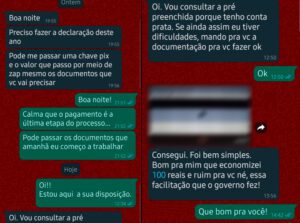
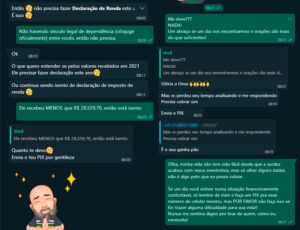
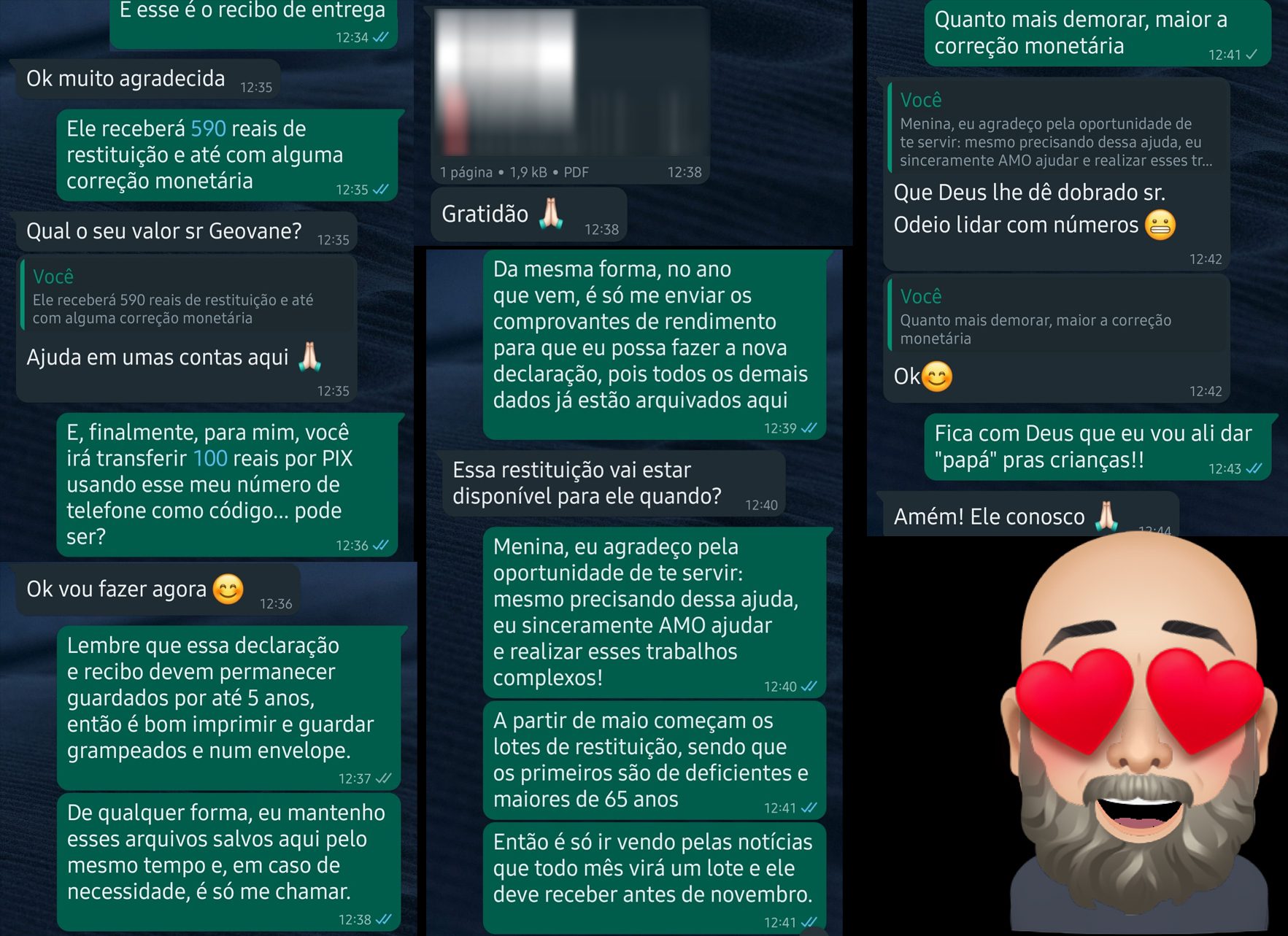
The joy of announcing that there will be a refund and the recognition of a job well done on technical grounds.
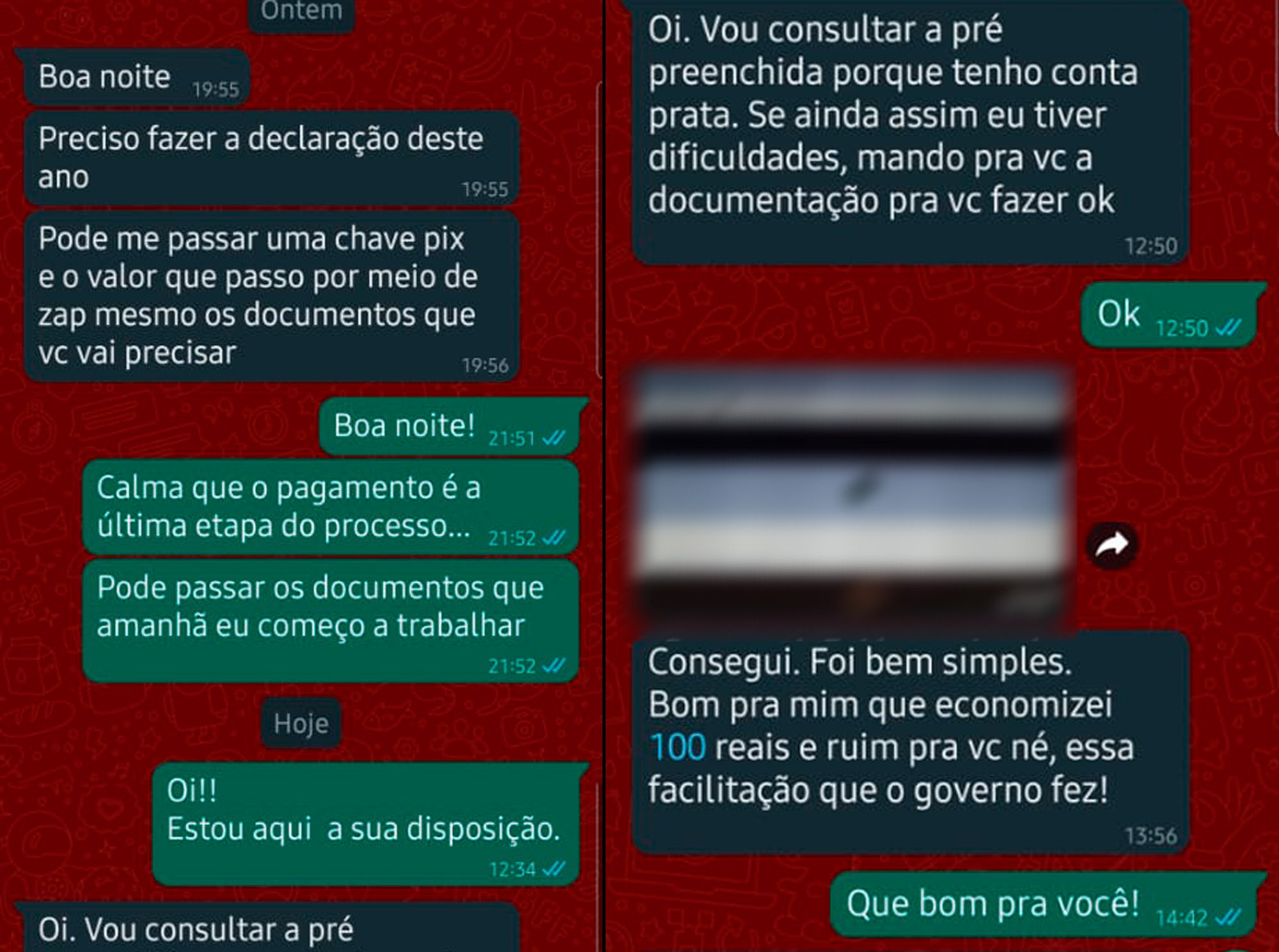
That moment when you help, but the "savings" of R$ 100 are worth more than professional ethics.
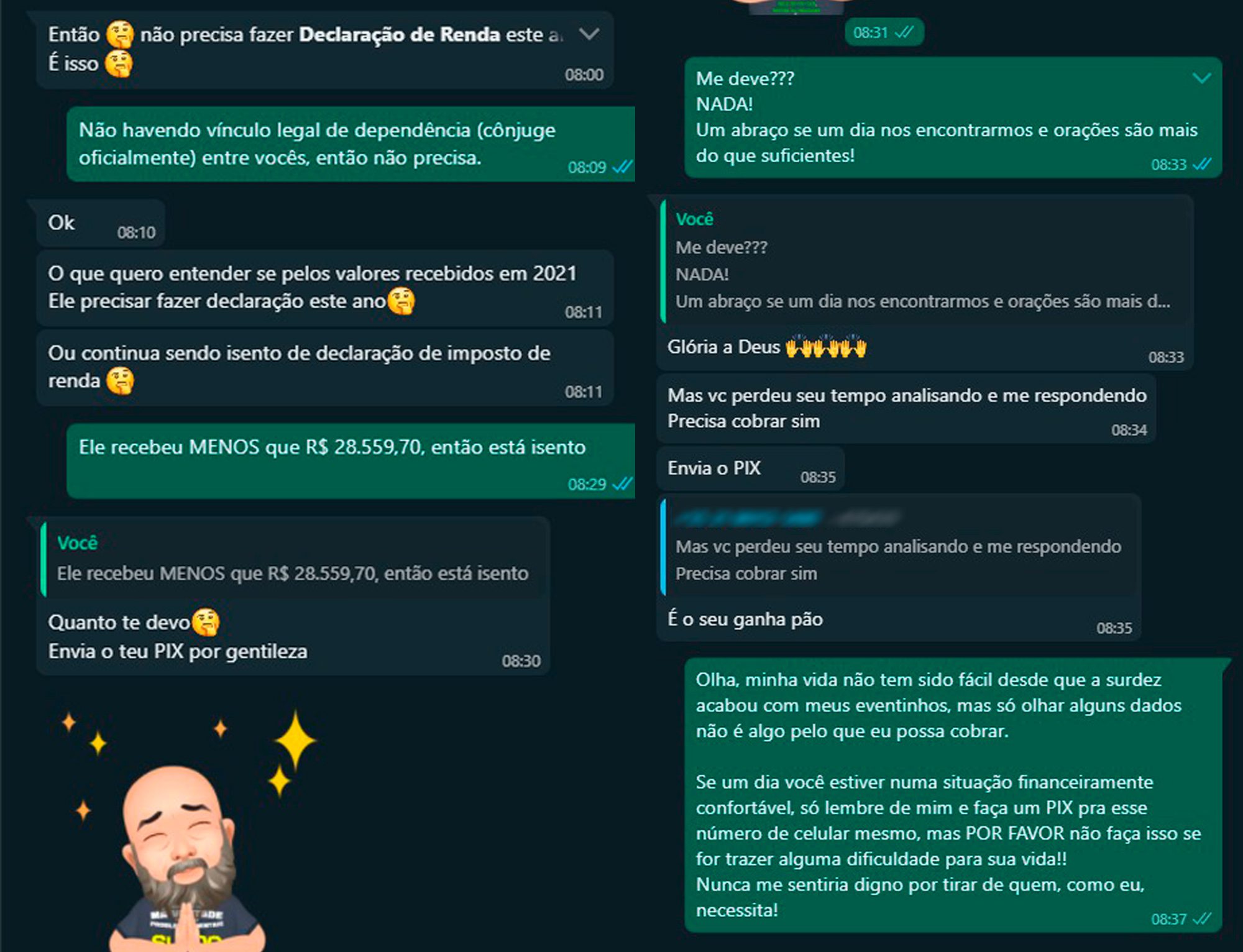
“"I would never feel worthy of taking from someone who, like me, is in need." Honesty comes before profit.
The Aliquot Trap: The Drama of Your Hallucinogenic Drug
I wish I could help people for free, but since... Deafness has caught up with me. Life has been absurdly difficult financially, especially since the pandemic hit… and whenever someone comes to me talking about “quotas for disabled people,” I try to explain the complex issue of the tax rates, which, coincidentally, Mr. Alucinético was a victim of just yesterday!

Widowed and retired since 2004, the annual income of his son, Alucinético, falls under the 15% tax bracket, but his daughter has been frequenting funk parties and, while doing various dance moves, ended up having a pair of grandchildren who live in his house, but of whom he does not have legal custody.
A full house, inflation, several outstanding debts… to alleviate the financial strain, Alucinético accepted a formal, side job that a close friend had been persistently suggesting, in the hope that they could work together again after so many years.
The fact is that while this modest salary — falling under the 7.5% tax bracket — managed to ease the burden of electricity bills and grandchildren's school fees, it ended the peace of retirement, forcing its "Alucinético" to once again wake up in the middle of the night to face some form of the absolutely chaotic Rio de Janeiro public transport system and, to top it all off, a boss whose friendliness was limited to the moment of welcoming the "new old" employee to the company.
Knowing Alucinético's skills, in just over a year at the company, he was already bearing the responsibilities of the highest positions, which the younger (and better-paid) incumbents occasionally failed to perform: if the initial proposal was for a more relaxed activity, more compatible with the age of someone retired, the reality was that this grandfather of a family was arriving home only around 10:00 PM... and waking up at 5:00 AM the next day!
The first toll of this adventure was paid in terms of health, with painful digestive and bone damage.

The second installment came earlier this week, when he brought the documents for me to prepare his tax return: if his first source of income was taxed at source at a rate of 15% and this second, painful activity was taxed at 7.5%, adding the two together placed him at the "top of the tax pyramid," forcing him to calculate the painful rate of 27.5% on the total amount of his earnings!

I tried to use every possible mitigating factor, but your daughter, besides being over 24 years old, has never set foot in a university.
Except for himself, he pays for health insurance for everyone in the house and school for his grandchildren, but he does not have legal custody of them, which prevents him from declaring them as dependents.
Finally, having nowhere else to turn, I had to inform your Hallucinogenic that he owes two thousand two hundred and forty-three reais and fifty-five cents to the Federal Revenue Service and that, in the best-case scenario, we could convert this into eight installments of R$ 280.44 with automatic debit…
He sat down, and I couldn't help but notice his eyes welling up. He accepted the glass of water I offered and, after a deep sigh, asked me in a trembling voice:
Where am I going to get that money, little boy?
His anguish could easily be mine if, having retired from the Air Force, I were to accept any of the quota positions they've offered me, and then, when I didn't accept, they started whispering behind my back that I was being unwilling and didn't want to work…
The System That Punishes Those Who Work
Finally, today, Friday, I bumped into him taking his grandchildren to school and he only spoke briefly to me:
— I left that anguish behind in Barra!
I could tell that he wasn't exactly happy, but that, without a doubt and despite the uncertainties, there was relief in his voice.
Despite the names being changed, this text is absolutely not fiction and only allows me to conclude with a question to which I truly don't know the answer:
While welfare programs support the lazy, how can one be happy and prosper in a nation where the tax law was created to penalize those who work the hardest?!?
Thank you for reading this far, and I invite everyone to comment politely with their answers, if they have any…



Subscribe
Login
Please login to comment
0 Comments
Oldest